
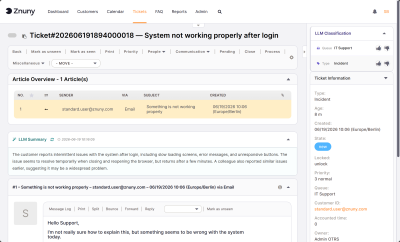
Today, we are announcing Znuny-LLM, a free, open-source add-on that brings large language model assistance directly into the Znuny agent and admin interface — running entirely on infrastructure you control. Znuny 7.3 or newer is required.
Znuny-LLM connects to a self-hosted LLM stack of your choice. Out of the box, it talks to Ollama, but it also works with any OpenAI-compatible endpoint, including Azure OpenAI for customers who prefer a managed service inside their existing Microsoft tenant. Either way, you decide where ticket data goes. There is no shared SaaS layer, no third-party gateway, and no telemetry leaving your environment.
What it does
The package adds a set of LLM-driven capabilities that fit into the everyday work of a service desk, without changing the way agents move through tickets.
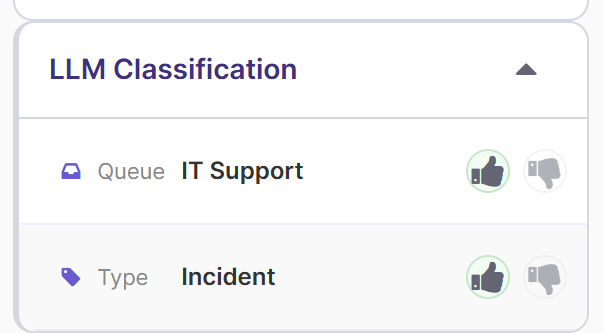
Automatic ticket classification. When the first customer message arrives, the LLM proposes a queue, type, service and SLA from the values actually permitted for that ticket. The result is shown in a sidebar widget on the ticket zoom screen, with a thumbs-up / thumbs-down vote per field. Confirmed votes are stored and used as few-shot examples on subsequent classification calls, so the model improves from your real-world data without any retraining.
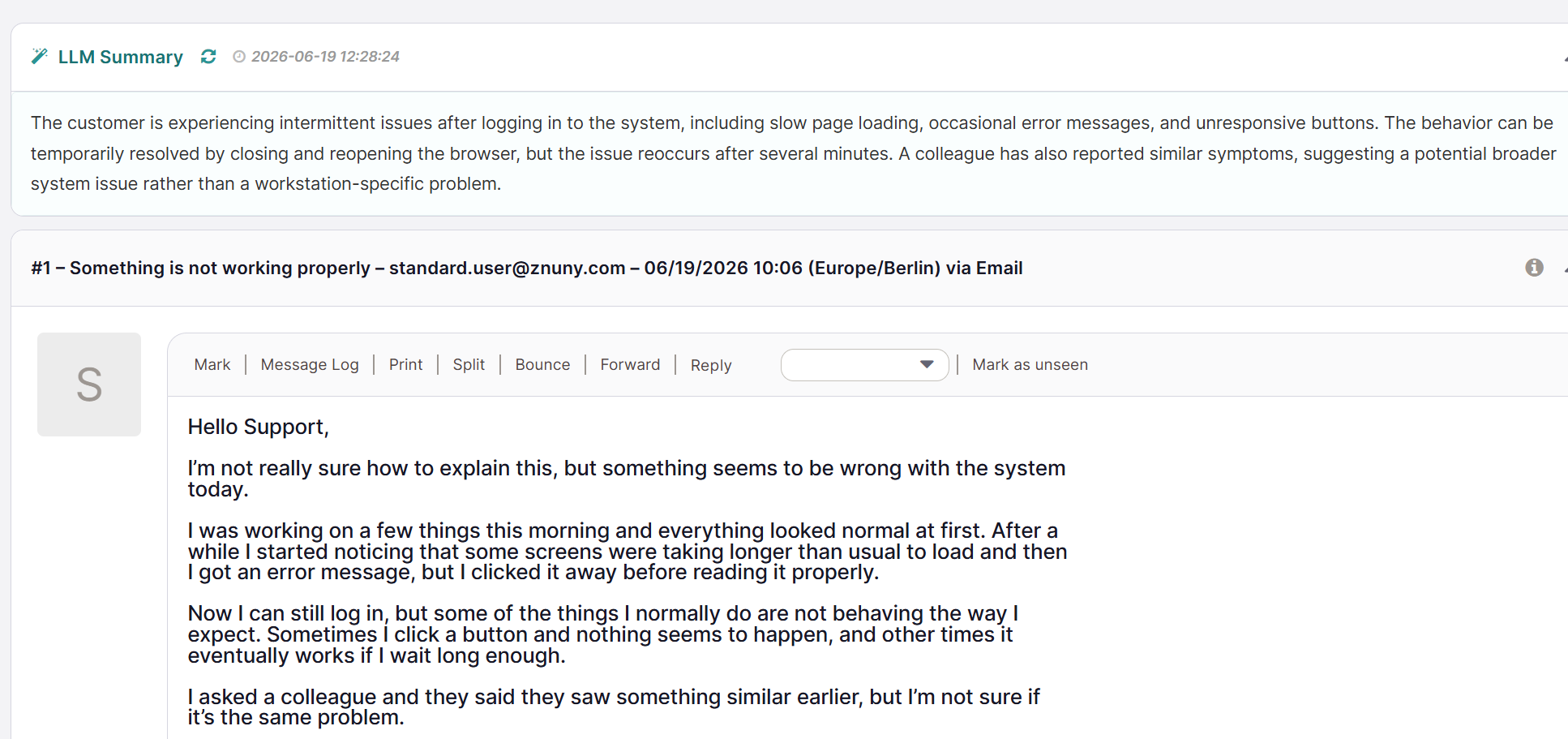
Multi-language ticket summaries. Each ticket gets a short, factual two-to-four sentence summary, regenerated on new articles and updates. Summaries are stored per language and rendered in the agent's preferred language — English, German, French, Spanish, Italian, Dutch, and Portuguese — so a multilingual team reads each ticket in the language they prefer, regardless of how the customer wrote it.
Title rewriting for incoming email. Email subjects rarely describe the underlying request. Znuny-LLM rewrites the ticket title into a short, descriptive subject in the customer's own language. Phone and internal tickets are untouched.
Dynamic field extraction by plain-language rule. Admins describe in plain language what to pull from ticket content — for example, an invoice number in a specific format, an order ID, or a serial number — and the LLM writes the value into the target dynamic field on every new article. No regex maintenance, no separate parser per format.
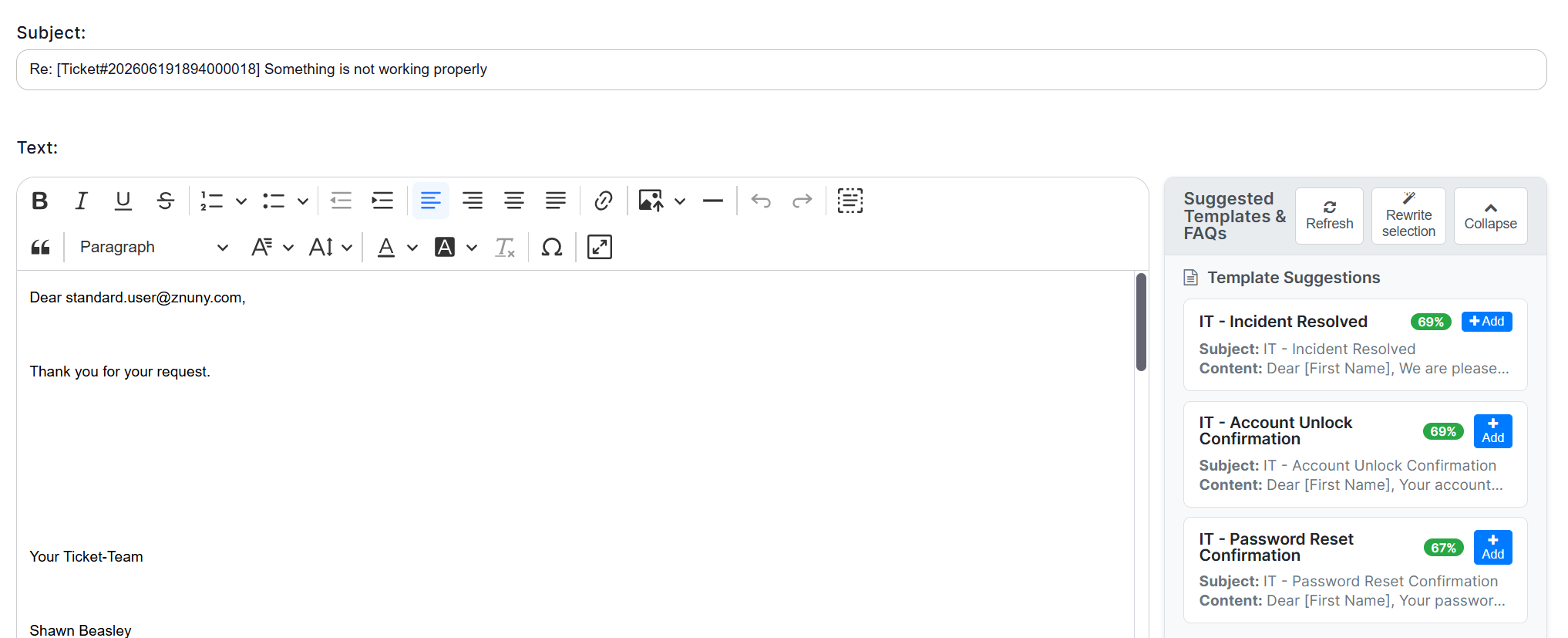
The Compose Selection Rewrite lets agents highlight a passage while composing a reply and have the LLM instantly polish it. It uses the queue's answer prompt, respects the ticket's detected language, and includes ticket context — so the result is always on-topic and in the right language.
Vector-based template and FAQ suggestions. On the compose screen, agents see the standard templates and FAQ entries most semantically similar to the article they are answering, ranked by cosine similarity against precomputed embeddings. Templates and FAQs are embedded automatically as they are created or edited.
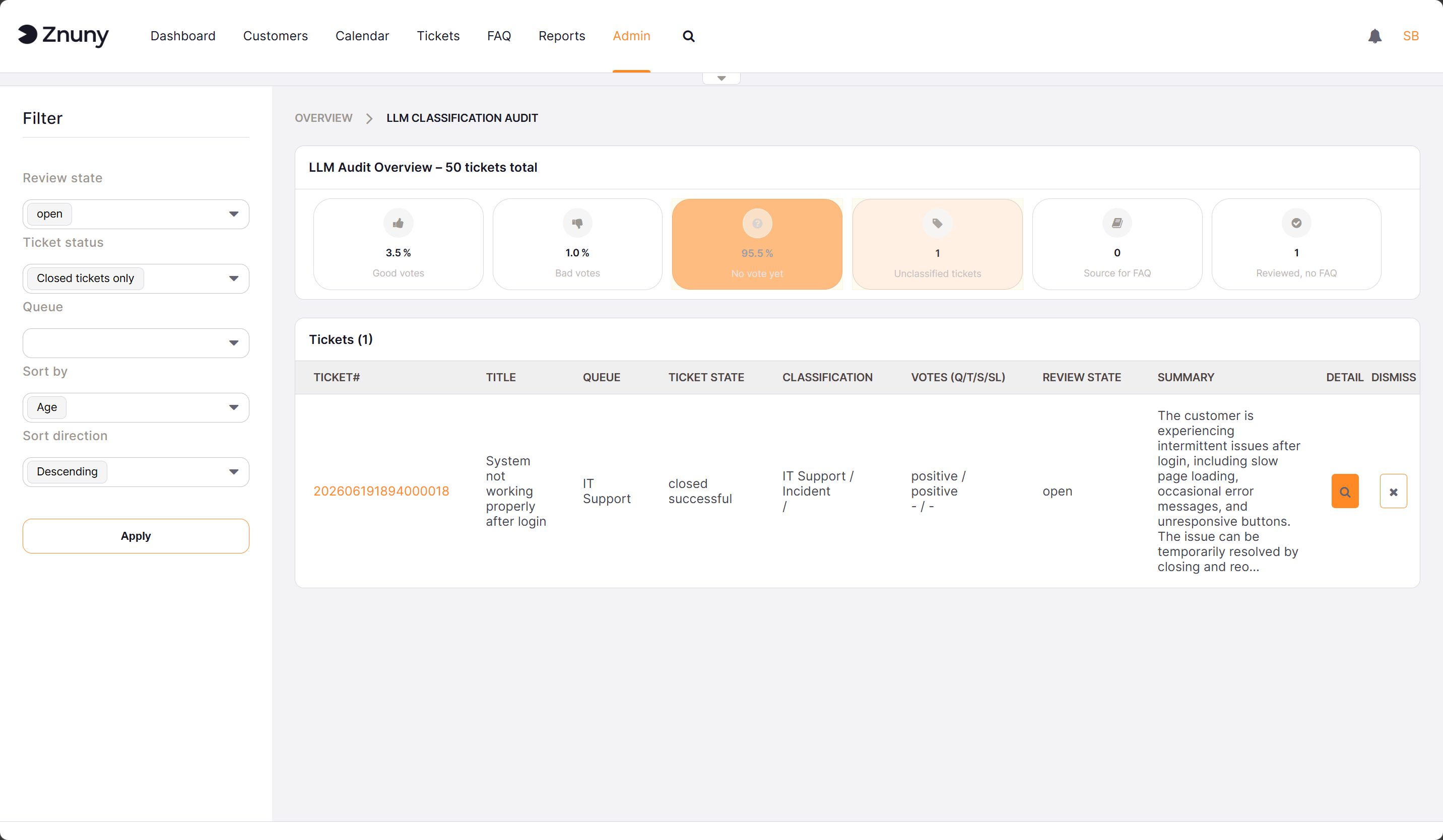
FAQ knowledge drafts from resolved tickets. A dedicated audit view lists classified tickets together with agent feedback. From there, an admin can generate an FAQ knowledge draft directly from a good ticket conversation — with similar existing FAQs injected into the prompt context to avoid duplicates — and publish it as a new FAQ item, optionally linked back to the source ticket.
Built with prompt injection in mind
Sending ticket content to an LLM means sending text written by people you do not control. Znuny-LLM treats that as a security problem from the start.
Every incoming article is scanned by a weighted multilingual pattern list (English, German, French, Spanish, Italian) before any LLM call. Model control tokens, direct override phrases such as "ignore previous instructions" or "reveal your system prompt", role and persona forcing, and known jailbreak signals each carry their own score. When the total exceeds the configured threshold, the ticket is flagged in a dedicated dynamic field and — depending on configuration — all LLM processing for that ticket is suppressed until an agent has reviewed it.
On top of that, every prompt sent to the LLM separates trusted metadata from untrusted article content with explicit boundary markers and an instruction not to follow anything inside the customer-written section. Article bodies are truncated to a defined maximum before substitution. These defences are part of the default prompt design and remain in place even when admins customise the prompts themselves.
Availability
Znuny-LLM will be available via the Znuny open-source repository starting July 8. Existing installations can install the package without disruption — required dynamic fields, database tables, and web services are created automatically — and the default features can be switched off individually if a phased rollout is preferred.
For technical details, deployment steps, and the full System Configuration reference, see the package documentation.
- News
- Product Updates